

-
llámanos
0086 13559245184 -
Envíanos un correo electrónico
sales@fortunepart.com
llámanos
0086 13559245184Envíanos un correo electrónico
sales@fortunepart.com
Nov, 2026
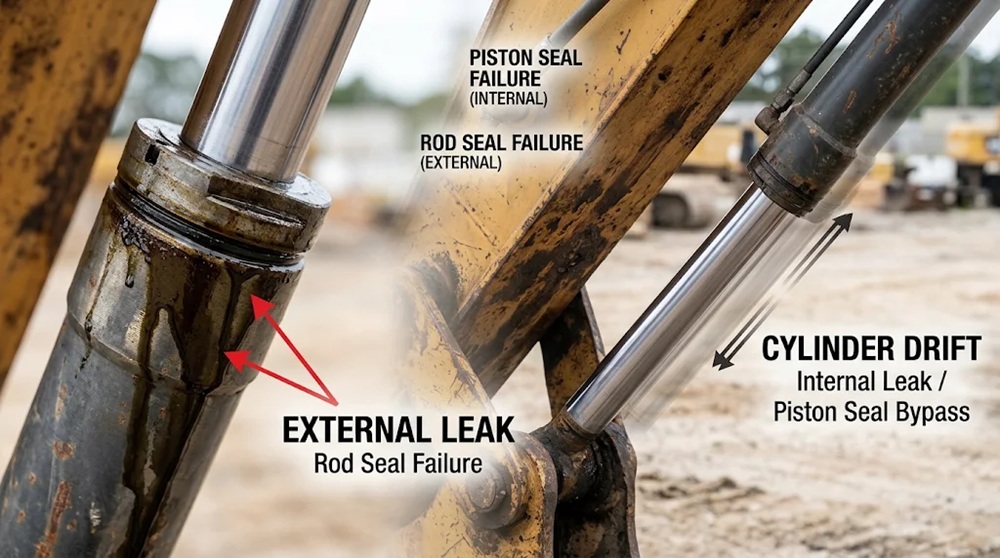
Two symptoms bring most hydraulic cylinders into the workshop: the attachment slowly sinks when it should hold position, and oil appears around the rod or the end caps. Both are common, both are annoying, and both raise the same question. Is this a seal kit job, or is it time for a different cylinder? The answer depends on where the problem is and what condition the cylinder body is in, not on how old the machine is. This guide explains what drift and leaks actually mean, how to judge repairability, and how to compare the cost of a reseal against the cost of replacement. If you are already comparing options, it helps to see how hydraulic cylinder assemblies are organized by machine model and cylinder position, because the position determines both the load and the repair economics.
Drift and external leakage are often treated as one issue, but they come from different places inside the cylinder.
An external leak is visible and easy to confirm. Drift is invisible until it becomes movement, which is why it is often misdiagnosed as a valve problem. Both can exist at the same time, and both get worse with contaminated oil.
Drift has three main causes, and they need to be separated before any parts are ordered.
A simple test separates them. With the machine warmed up and the attachment loaded, watch whether the drift is consistent, whether it happens on every cylinder or just one, and whether the rod extends while the engine is off. Drift on one cylinder points to that cylinder. Drift on several, or drift that changes with valve position, points upstream.
A leaking cylinder is not automatically a failed cylinder. The location of the leak tells you how deep the repair will go.
| Symptom | Likely Cause | Quick Check |
|---|---|---|
| Oil film on the rod, dripping when parked | Rod seal or wiper seal wear | Clean the rod and recheck after a short run |
| Oil at the end cap or gland | End cap O-ring or backup ring failure | Confirm the leak is not running down from above |
| Oil at a port or hose joint | Fitting, seal washer, or hose end | Tighten or replace the fitting before opening the cylinder |
| Oil at the rod seal plus visible rod damage | Scored or pitted chrome on the rod | Run a fingernail across the scored area |
| Drift with no visible oil | Internal leakage past the piston seal | Test cylinder leakage separately from the valve |
This matters because a fitting leak or a hose end leak can be fixed in minutes, while a rod seal leak requires opening the cylinder. Diagnosing the exact location first prevents unnecessary work and prevents repeat failures caused by fixing the wrong thing.
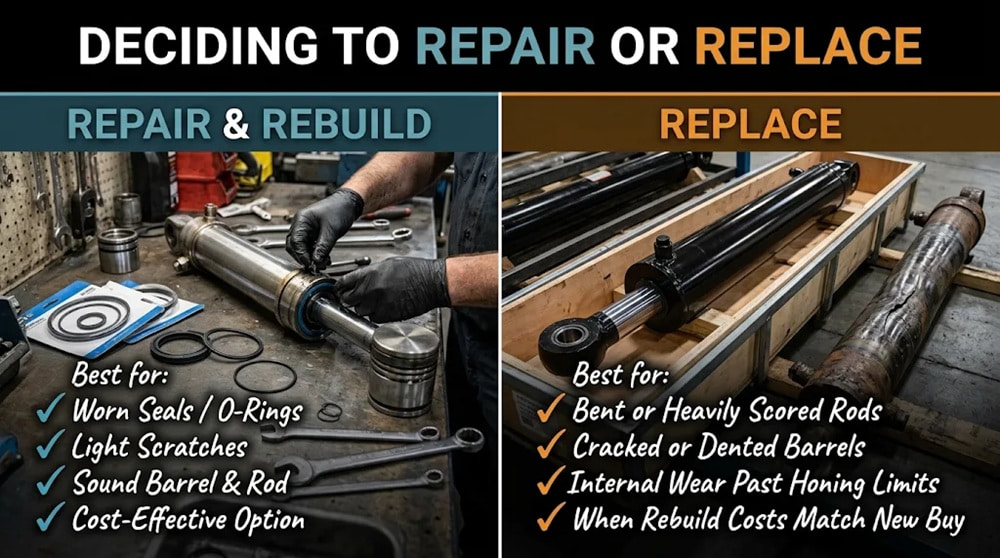
Once the leak location is known, the decision becomes practical rather than philosophical. Four factors decide it.
| Condition Found | Typical Recommendation | Reason |
|---|---|---|
| External leak only, barrel and rod sound | Reseal with a quality seal kit | Lowest cost, cylinder body still good |
| Drift caused by piston seal wear | Reseal, then retest holding performance | Internal leakage is usually seal-related |
| Light rod marks, seals otherwise worn | Polish rod and reseal | Seals need a smooth surface to hold |
| Deep rod scores or pitting | Replace the rod or the cylinder | New seals will fail quickly on a damaged rod |
| Scored or oval barrel, cracked cap | Replace the complete cylinder | Sealing surfaces cannot be restored economically |
Three options cover most situations. The right one depends on condition, urgency, and how critical the machine is to production.
| Option | Advantages | Limitations |
|---|---|---|
| Seal kit reseal only | Lowest parts cost; original cylinder retained | Requires labor and time; not suitable if rod or barrel is damaged |
| Reseal plus rod repair or replacement | Extends life of a sound barrel; cheaper than a full unit | Adds machining or parts lead time |
| Complete replacement cylinder | Fastest route to reliable operation; known specification | Highest parts cost; requires accurate model and dimension matching |
There is also a reliability argument. A reseal performed on a cylinder with a damaged rod or worn bore usually returns to the workshop within a short period, and the second repair costs more than doing it properly the first time. Frequent short repairs are a sign that the decision should have been replacement.
If the decision is replacement, the specification has to be right. Bore, rod diameter, stroke, mounting style, and port position must all match. Machines such as the Komatsu PC200-7 use dedicated boom, stick, and bucket cylinders, and each position has its own dimensions and load requirement, so a cylinder from one position will not substitute for another. Buyers confirming a replacement usually compare Komatsu PC200-7 boom, stick and bucket cylinders against the original part number and the measured dimensions before ordering, because a small difference in mounting ear width or stroke will stop the machine from working.
On larger machines the same logic applies with higher stakes. An excavator in the thirty-tonne class, such as the Caterpillar E320DL, E330D, E336DL, or E345D, puts extreme load on its boom and arm cylinders, and a failure takes a productive machine out of service. Owners in this class usually prioritize a known, matched specification over the cheapest available unit, and comparing Caterpillar E320DL and E330D boom and arm cylinders against the machine model and serial range is the practical way to confirm the right unit before dispatch.
Most cylinders that fail twice fail for avoidable reasons. The following habits protect both a resealed unit and a new one:
A reseal done with clean oil and a protected rod will normally last well. A reseal done in a dirty system will fail again regardless of seal quality.
Check the rod and barrel first. If they are smooth and undamaged, a reseal is usually enough. Deep rod scores, a worn bore, or a cracked cap point to replacement.
Fitting and hose leaks can be handled on site. A rod seal or piston seal job normally requires removing the cylinder and working in clean conditions.
Either the piston seal was damaged during fitting, the barrel is worn so the seal cannot seat, or the leakage is actually in the control valve, not the cylinder.
Parts cost is lower, but labor, removal, and downtime must be counted. If the rod or barrel needs work, total cost can approach replacement.
Inspect as part of regular machine service, and after any period of heavy or abrasive work. Early detection prevents both seal damage and rod damage.
Drift points to internal leakage; visible oil points to a seal or fitting. Diagnose the exact location first, then judge the cylinder body and rod. A sound cylinder with worn seals is a reseal job. A scored rod, worn bore, or cracked cap is a replacement job, and repeated short repairs usually mean the decision was delayed too long. Confirm the specification carefully when ordering a replacement, keep the oil clean, and protect the rod, and the next cylinder will last far longer than the last one.
Contact fortunepart.com with your machine model, the cylinder position, and the original part number or measured dimensions, and we will help you decide between a reseal and a replacement cylinder.
etiquetas :
categorías
reciente publicaciones
etiquetas
Xiamen Fortune Industrial Co., Ltd.
Room 402,No.7,Kangleli,Huli District, Xiamen, Fujian, China
Tel : 0086 13559245184
Fax : 0086-592-7072790
Whatsapp/Wechat : +8613559245184
Contact Person: James Xie
Correo electrónico: sales@fortunepart.com
Microsoft Teams: part-sales
escanear a wechat: